Family: Bufonidae (True Toads)
Genus: Anaxyrus (North American Toads)
|
|
|
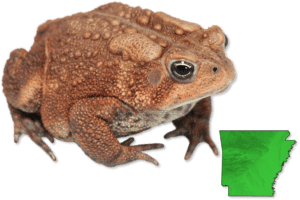
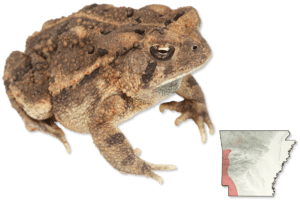
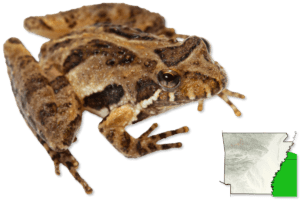
| Color variable, though usually a rusty-red. Skin dry with 1-2 warts per dark spot (some individuals without spots). Chest speckled with black. Parotoid gland kidney-shaped and separated from eye ridge or attached by spur. Known to hybridize with other True Toads. Call a melodic trill.
|
|
|
|
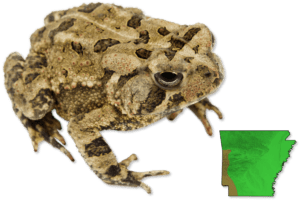
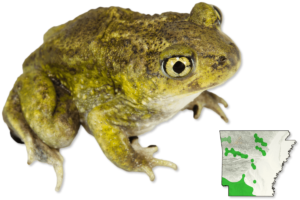
| Color variable, though usually shades of brown. Skin dry with 3 or more warts per dark spot. Chest usually plain or with one breast spot. Parotoid gland oval-shaped and touching eye ridge. Known to hybridize with other True Toads. Call a short "whaaat".
|
|
|
|
Family: Hylidae (Treefrogs)
Genera: Acris (Cricket Frogs), Hyla (Holarctic Treefrogs), and Pseudacris (Chorus Frogs)
|
|
|
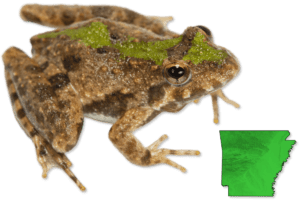
| Small. Highly variable in color (browns, grays, greens, etc.) and pattern (plain, mottled, etc.). Back of head with darker triangular mark (not always obvious). Upper lip with 4-5 dark bars (not always obvious). Call cricket-like clicks, or as though two small pebbles were being chipped together.
|
|
|
|
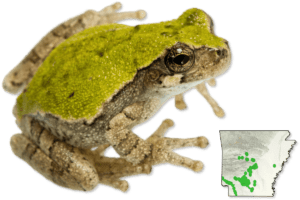
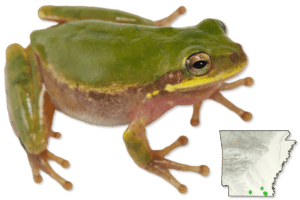
| Rare. Highly variable and can change colors, but usually shades of green and/or gray. Toe pads sticky. Skin smooth. Inside of legs yellowish-green. White spot under eye. Call bird-like with 2-5 whistles per second.
|
|
|
|
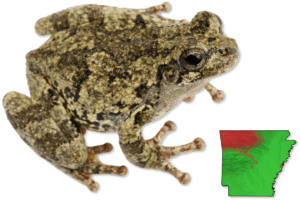
| Species of Gray Treefrog Complex (diploid). Highly variable and can change colors, but usually shades of green and/or gray. Toe pads sticky. Skin granular. Inside of legs bright yellowish-orange. White spot under eye. Call a fast trill.
|
|
|
|
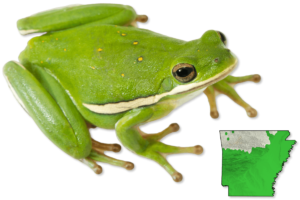
| Color bright green with a prominent white stripe from upper lip to thigh. Toe pads sticky. Skin smooth. Call a duck-like quack.
|
|
|
|
| Species of Gray Treefrog Complex (tetraploid). Highly variable and can change colors, but usually shades of green and/or gray. Toe pads sticky. Skin granular. Inside of legs bright yellowish-orange. White spot under eye. Call a slow trill.
|
|
|
|
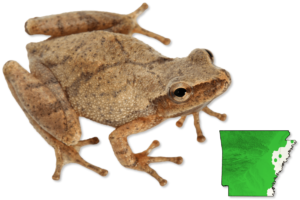
| Small. Color varying shades of tan and brown. Darker cross pattern on back. Toe pads sticky. Call in early spring a loud "peep".
|
|
|
|
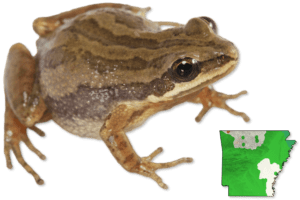
| Small. Color grays and browns. Dark stripe from snout to groin. 3 dark, thin (and usually broken) dorsal stripes. Upper lip light. Call a "thumbnail raking a plastic comb" (from low to high pitch).
|
|
|
|
| Rare with the only confirmed AR specimens from the vicinity of Pea Ridge, Benton County. Small. Color grays and browns. Dark stripe from snout to groin. 3 dark, thin (and usually broken) dorsal stripes. Upper lip light. Call a "thumbnail raking a plastic comb" (from low to high pitch); noticeably faster pulse rate than P. fouquettei.
|
|
|
|
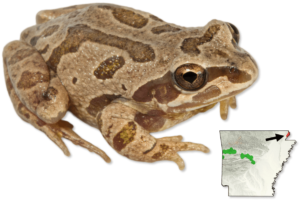
| Rare. Color grayish or tanish. Dark, irregular dorsal blotches; sometimes very faint or not present. Dark stripe from eye to shoulder. Groin often yellow. Populations in extreme NE Arkansas may hold unique characteristics ( ). Call a bell-like whistle.
|
|
|
|
Family: Microhylidae (Microhylid Frogs and Toads)
Genus: Gastrophryne (North American Narrow-mouthed Toads)
|
|
|
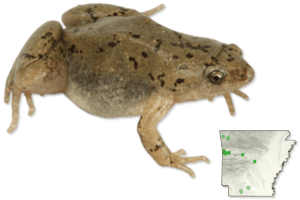
| Small and squat. Mottled brown. Belly mottled black and grey. Head small and very pointed. Fold of skin behind eyes. Call a loud, long "baaaw of a dying sheep".
|
|
|
|
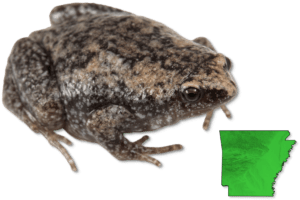
| Small and squat. Light gray (sometimes with a few small black specks). Belly plain. Head small and very pointed. Fold of skin behind eyes. Call a short "peep" followed by an "angry bee" buzz.
|
|
|
|
Family: Ranidae (True Frogs)
Genus: Lithobates (American Water Frogs)
|
|
|
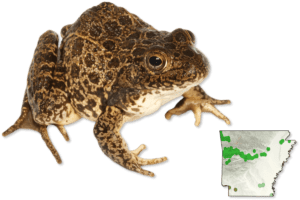
| Rare. Large. Covered in large, dark spots ringed with light borders. Dorsolateral fold. Call a loud, deep "snoring hog".
|
|
Subspecies: Southern Crawfish Frog (L. a. areolatus) and Northern Crawfish Frog (R. a. circulosus)
|
|
|
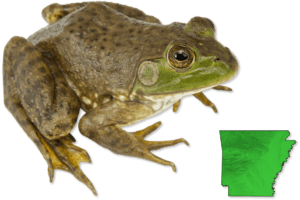
| Very large as adult. Green or brown (usually rather patternless). Tympanum large with fold of skin wrapping around it. Dorsolateral fold absent. Call a low-pitched "bellowing bull".
|
|
|
|
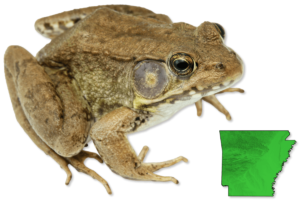
| Very large as adult. Green or bronze (usually rather patternless). Tympanum large. Dorsolateral fold present. Call a "loose banjo string".
|
|
|
|
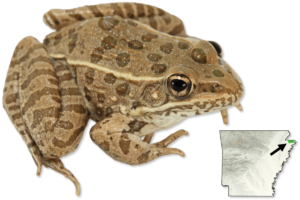
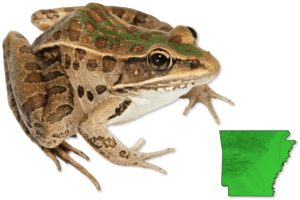
| Metallic-like sheen. Light gray, tan, or yellowish background with leopard-like dark spots. Spots on back squarish and paired. Dark bars on back legs. Inside thigh yellowish. Dorsolateral fold. Call a quiet, low-pitched, 1-2 second "snore".
|
|
|
|
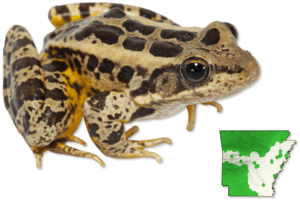
| Color shades of green or brown and always spotted like a "leopard". Spots round and random. No dark spot on snout. No distinct spot on tympanum. Light line on upper lip. Dark bars on back legs. Dorsolateral fold not broken (or, if broken, in the same line). Inside thigh not yellowish. Call a series of quiet "chuckling quacks".
|
|
|
|
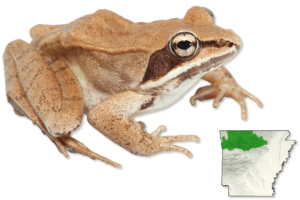
| Rare. Tan with a distinctive black "mask" and light upper lip. Dorsolateral folds. Call a quiet "hoarse duck".
|
|
|
|
Family: Scaphiopodidae (North American Spadefoots)
Genera: Scaphiopus (North American Spadefoots) and Spea (Western Spadefoots)
|
|
|
| Rare. Color variable, but usually brownish. Two light dorsal lines. Skin moist. Parotoid glands not obvious. No raised bump between eyes. Eye pupils vertically elliptical. Dark "spade" on bottom of foot long and sickle-shaped. Call a loud "grunt".
|
|
|
|
| Rare. Color variable, but usually greenish. Two light dorsal lines. Skin moist. Parotoid glands not obvious. Raised bump between and slightly behind eyes. Eye pupils vertically elliptical. Dark "spade" on bottom of foot sickle-shaped. Call a loud "grunt".
|
|
|
|
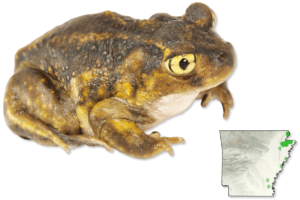
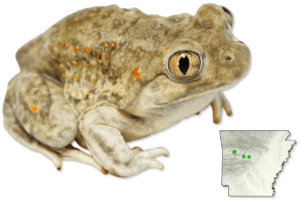
| Rare with only three known localities in AR. Color grayish or bluish with small, red spots. Skin moist. Parotoid glands not obvious. Raised bump between eyes. Eye pupils vertically elliptical. Dark "spade" on bottom of foot rounded. Call a short "snore".
|
|
|
|
~ Hypothetical Occurrence ~
|
|
|
| Rare with no vouchered specimen for AR. (Populations in the state previously identified as this species have been reclassified as A. blanchardi.) Small. Highly variable in color (browns, grays, greens, etc.) and pattern (plain, mottled, etc.). Back of head with darker triangular mark (not always obvious). Upper lip with 4-5 dark bars (not always obvious). Call cricket-like clicks, or as though two small pebbles were being chipped together.
|
|
|
|
| Rare with no vouchered specimen for AR. Small. Highly variable in color (browns, grays, greens, etc.) and pattern (plain, mottled, etc.). Back of head with darker triangular mark (not always obvious). Upper lip with 4-5 dark bars (not always obvious). Typically more slender, longer-legged, with a well-defined dark stripe on the rear thigh, and with more pointed snout than A. blanchardi. Call cricket-like clicks, or as though two small pebbles were being chipped together.
|
|
|
|
| Rare with no vouchered specimen for AR. Color variable, though usually shades of gray or brown. Skin dry and typically with reddish warts. Parotoid gland is round. Call a high-pitched musical trill.
|
|
|
|
| Hybridizes readily with other True Toads and a pure AR specimen may not be obtainable. Color variable, though usually grayish. Skin dry with the number of warts variable (1 or more) per dark spot. Chest usually plain. Parotoid gland oval-shaped and touching eye ridge. Known to hybridize with other True Toads. Call a short "whaaat".
|
|
|
|
| Rare with no vouchered specimen for AR. Largish treefrog. Color varies in shades of green or brown. Profusion of dark, round markings. Call a resonant "toonk" repeated once per second.
|
|
|
|
| Rare with no vouchered specimen for AR. Color green or brown. Light dorsal spots and vague stripe along the side may be present. Toe pads sticky. Skin smooth. Call a nasally, buzzing quack.
|
|
|
|
| Rare with no known breeding populations in AR. (Single vouchered specimen from Union County was likely the result of stocking a lake with fish from Louisiana.) Color variable, but with dark lateral stripe bordered above by light stripe. Skin dry and warty. Parotoid glad triangular with eye crests forming a deep crease on head. Call a series of "wooden rattle" trills.
|
|
|
|
| Rare with only a single vouchered specimen from AR. (No breeding populations have been confirmed.) Color shades of brown (never green) and always spotted like a "leopard". Spots round and random. Dark spot on snout. Light spot on tympanum. Distinct light line on upper lip. Dark bars on back legs. Dorsolateral fold broken near groin. Inside thigh yellowish. Call a series of 2-3 throaty "gulps".
|
|
|
|
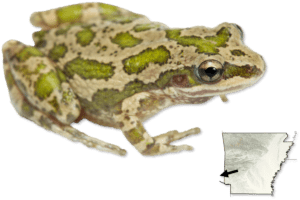
| Rare with no vouchered specimen for AR. Background color a shade of gray or green. Spots typically green and bordered in black. Usually a triangular-shaped spot behind eyes. Call a rasping "rrrack-rrrack-rrrack".
|
|
|
|
| Rare with no vouchered specimen for AR. Small. Color grays and browns. Dark stripe from snout to groin. 3 dark, thin (and usually broken) dorsal stripes. Upper lip light. Call a "thumbnail raking a plastic comb" (from low to high pitch); noticeably faster pulse rate than P. fouquettei.
|
|
|
|
|
|
|
|